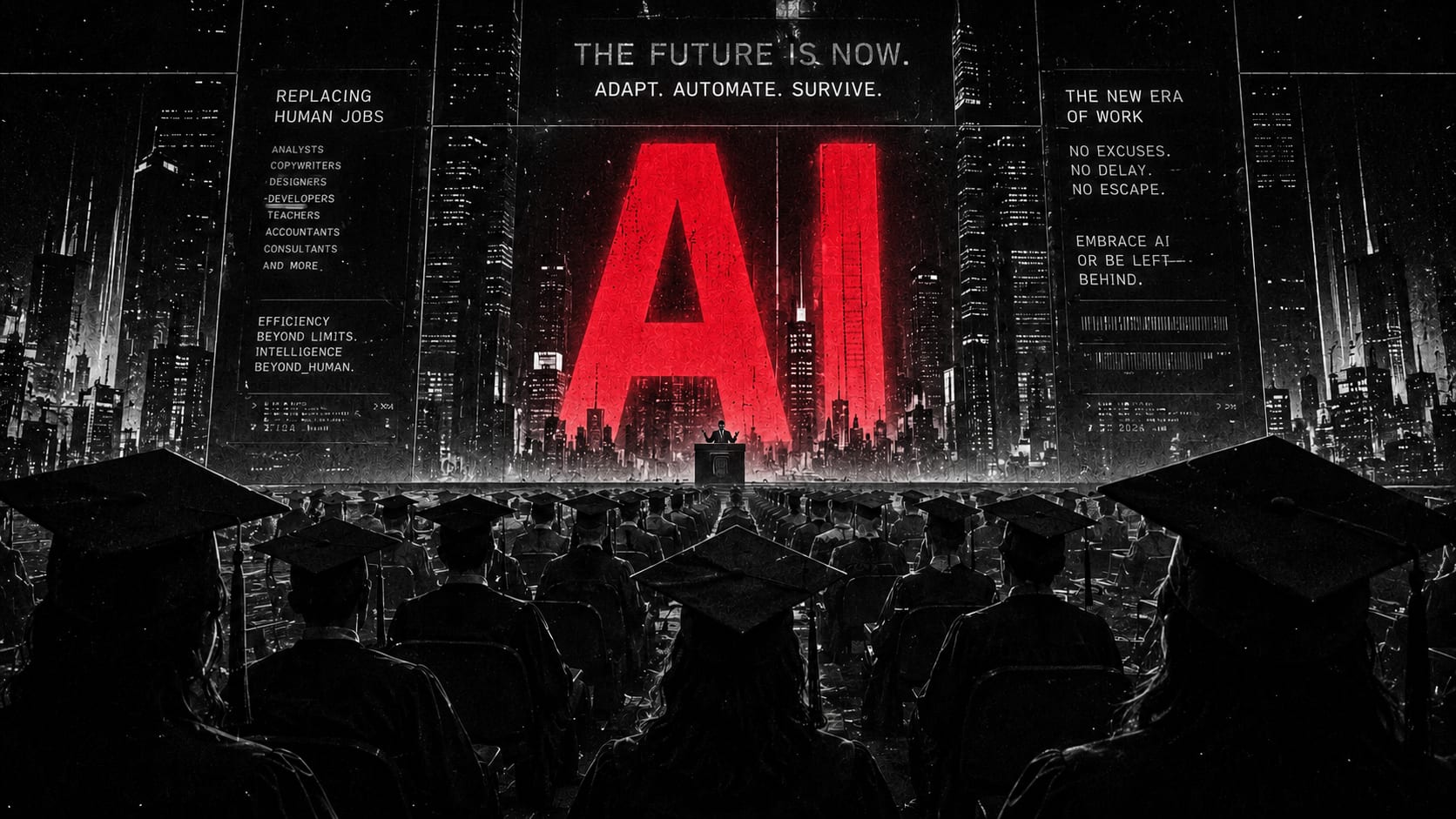
As graduation season approaches, the hottest news in the U.S. is tech company CEOs touring universities to give speeches. Over the years, many such events have produced memorable quotes, and some speeches have even gone down in history. For example, Steve Jobs' 2005 speech at Stanford University is a classic, with the line "Stay Hungry. Stay Foolish" becoming a spiritual slogan for many artistic geeks.
But this year is a bit different. When former Google CEO Eric Schmidt mentioned at the University of Arizona's commencement that AI would shape the world and encouraged graduates to actively shape AI, the crowd erupted in boos multiple times. Similar scenes occurred with real estate executive Gloria Caulfield and Big Machine Records CEO Scott Borchetta.
This scene is quite interesting. On one hand, the tech industry is shouting "AI Revolution," while on the other hand, more and more young people are growing tired of AI. In these CEOs' narratives, a large number of basic jobs will be replaced by AI, and young people should actively embrace AI and participate in the world's transformation. This kind of narrative that tells you to come and strive while simultaneously saying you'll inevitably be trampled is absurd enough to make you feel sorry for them. It's no wonder the young people in the audience responded with boos—after all, anyone listening would think the "old guys" on stage have mental issues.
In various self-media and capital narratives, we should already be living in a world largely taken over by AI. Even if not changing daily, at least there should be planes, rockets, and robots running everywhere. But after three years of hustle and bustle, what has actually materialized? Is it the all-in-one devices gathering dust, the Mac minis about to gather dust, exploding token bills, a bunch of neglected apps, or another batch of newly registered OPCs?
Although many "futures" are still far from realization, the entire internet seems to have been celebrating New Year's for over a thousand days straight. They talk about the "future," but always like to package the story as if it has already happened.
The biggest difference between a forward-looking observation being "forward-looking" or a "prophecy" is whether it carries a time attribute.
Over the past three years, we've heard countless stories about "AI" and the "future." Without exception, these stories talk about how AI will change the world and replace humans. If you're observant enough, you'll notice these stories are dressed up as forward-looking observations, seriously analyzing a lot of history, citing the steam engine's industrial revolution and the semiconductor's information revolution, trying to prove that every technological leap will redefine human society, but never saying how far away this so-called "future" really is.
Will AI take over a large number of jobs in 10 years or 20 years? Will AI restructure society, and how? How long will it take to restructure? What will society look like after restructuring? They are always evasive about these "details," or brush them off lightly, as if these questions are completely unimportant to them.
Historical technological changes didn't happen overnight; they were decades-long social restructurings and rebalancing of production relations. But some self-media deliberately erase the distance between the future and reality, packaging a long-term possible trend as a destiny that has already begun to unfold. A long-term trend that would normally take decades to gradually evolve is violently compressed into a month, a week, or even a short video's "sudden," "explosive," "immediate," "disruptive" narrative.
What's even more interesting is that this pre-consumption of the "future" doesn't just exist in self-media; it also exists in the capital market.
For self-media, "AI will eliminate you" naturally means traffic. Because what spreads most easily on the internet is never complex reality, but deterministic fear. Compared to "technology may gradually change social structure over the next few decades," "AI will soon eliminate 80% of white-collar workers" is clearly more suitable for clickbait and more likely to create anxiety and shares.
For the capital market, "AI" represents the future, and the "future" itself can be priced in advance.
It doesn't matter whether a company is actually making money; what matters is whether the company has a sexy and grand future story. Over the past two decades, the internet, the metaverse, and new energy have all played similar roles, and AI is clearly the newest, most effective, and most capable of making them climax on the spot.
In the past, when a company laid off employees, the market thought the company was in trouble. Now, when a company lays off employees, it can be packaged as an "AI strategic transformation" or "cost reduction and efficiency improvement." These are two completely different narratives. Especially for financially oriented CEOs, they are more inclined to control labor costs, increase profit margins, and optimize financial statements, and AI gives them a nearly perfect reason.
So we see more and more companies shouting about AI Native, digital employees, agents, and automation. A bunch of bosses chase after OpenClaw, intelligent agents, local deployment, token economy, and various "future office solutions" like dogs chasing a laser pointer, as if just by slapping on an AI label, the company can take off and become the next Nvidia.
But the real problems many companies face are not about AI or not; they are about sluggish market growth, the end of internet dividends leading to fierce competition in many industries, slowing growth, weak consumption, intensifying internal competition, and turning profits negative. AI is just a fig leaf, covering up their lack of imagination and the failure of their financially driven growth model.
They only tell you the facts, not the truth.
AI is indeed different from all previous technological changes. It's not just about improving tool efficiency; it's also starting to intervene in cognitive and decision-making processes in some areas. So it will profoundly change the entire world—that's a fact.
But the problem is that when "AI will change the world" is stripped of its time scale, organizational constraints, and real-world costs, it's no longer a serious technical discussion.
Compressing complex social evolution into simple judgments, cashing in on a long technological penetration process years or even decades in advance, and then packaging emotional consumption and capital gains as "individual value narratives" to complete a moral loop—these pre-confirmed "futures" are not the truth; they are just the most profitable slices of reality edited out.
People are not only workers but also consumers; they are both a company's cost and its profit.
A company that can completely operate without humans, managed entirely by AI, does not signify the arrival of a new era; it only shows that the company itself lacks complex social value. A "future" story detached from "people" is just a sci-fi novel full of illusions.
Moreover, if AI really eliminates all humans, who will pay taxes?