In 2006, Coca-Cola released an advertisement directed by Nagi Noda and scored by Jack White.
Legend has it that the 100-second full version was broadcast on television only once. The entire film was shot on celluloid, in one continuous take, relying on real actors, sets, and camera choreography rather than depending entirely on post-production effects. Every set and every second of blocking in the advertisement was perfectly synchronized—a precise performance achieved through careful planning and multiple rehearsals by the director, cinematographer, and actors.
This was the creation of the film era. Because every exposure, every retake, and every on-site coordination meant real costs, many brilliant ideas did not come from unlimited freedom, but from various constraints and careful design.
Meanwhile, constraints on creation existed not only on the set but also in distribution channels. The channels were narrower then—film, television, magazines, records, and advertising slots were not spaces easily accessible to everyone.
Narrow distribution channels meant that on one hand, numerous creators could not be seen, while on the other hand, many works that actually reached audiences had already undergone stricter selection.
But even classic works could not achieve longer lifecycles in such narrow exposure spaces.
The full version of this brilliant advertisement aired only once on British television; even at that year's Australian MTV Awards, only a 30-second version was shown. If advertising enthusiasts hadn't rediscovered it today, allowing it to be fully reintroduced to everyone, it would likely have become merely a forgotten part of history.
In the digital age, the cost structure changed. Shooting, storage, editing, and distribution became cheaper. Creators no longer had to make all judgments before starting; instead, they could produce in large quantities first, then select relatively good results from the footage.
Channels also became more open. Relying on the powerful information distribution capabilities of internet platforms, more ordinary people could publish their works, gain audiences, and enter the public eye. This certainly unleashed tremendous creative vitality, but it also brought another result: the number of works we encounter daily increased dramatically.
Much creative cost shifted to later promotion and advertising.
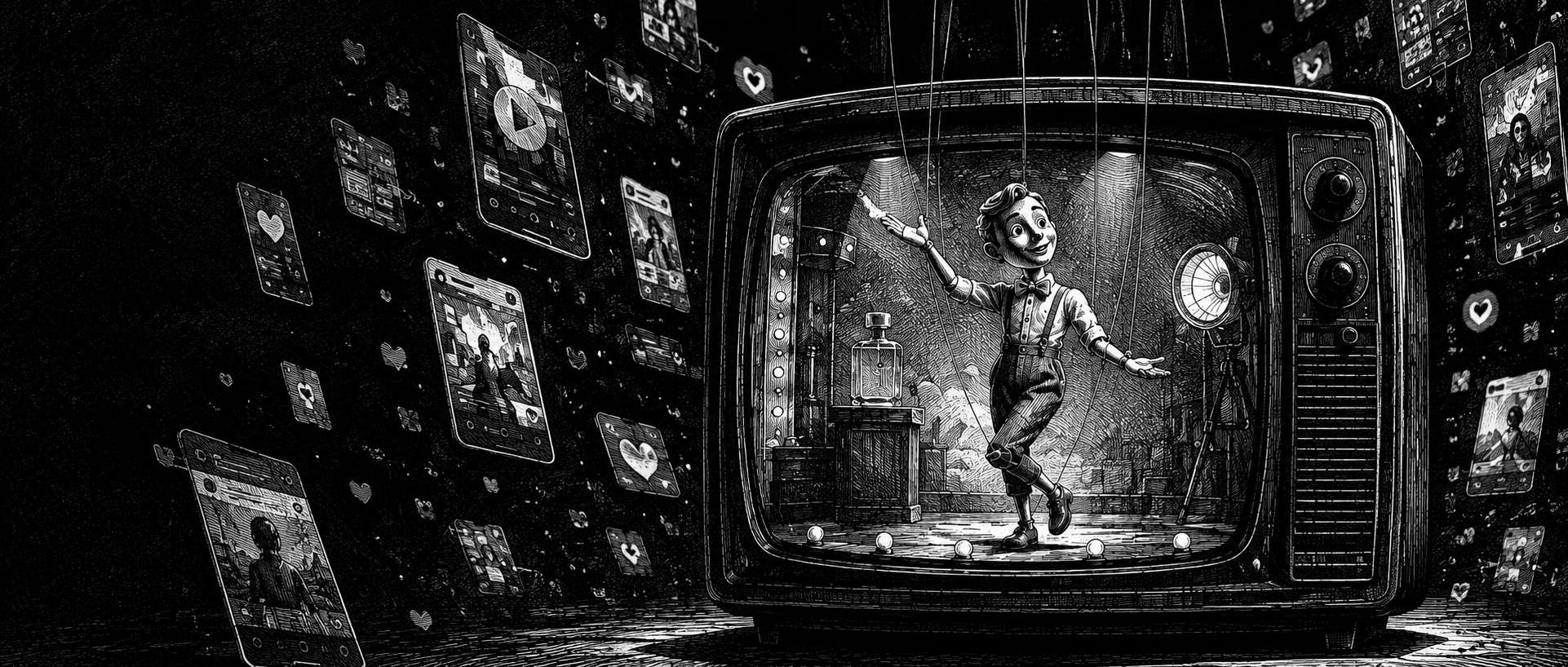
Traditional filtering mechanisms were weakened. No one pays attention to television stations and award ceremonies anymore; instead, they focus on content that can achieve emotional resonance within 3 seconds. From then on, attention became a truly scarce resource. The difficulty of creation shifted from "how to complete a precise performance" to "how to be seen, remembered, and believed among massive amounts of content."
The mobile internet era further amplified this change. As UGC (User Generated Content) expanded rapidly, platforms could no longer rely on editors and institutions to complete all screening as in the old media era. Thus, algorithmic recommendations and KOLs became new filtering mechanisms.
KOLs are not just people who produce content, but also nodes within interest communities. They filter information for users, explain the world, and organize attention. It seems that channels have become more open—everyone can publish, and everyone has a chance to be seen.
But in fact, the new distribution structure did not eliminate filtering; it merely transferred filtering from institutional editors to platform algorithms, social relationships, and key opinion leaders.
Some say that in the AI era, the most valuable thing is good ideas.
Charles Townes, in How the Laser Happened, quoted a remark by Richard Feynman: The way to judge whether an idea is great is to see if people say, "My God, I could have thought of that," when they hear it.
This quote aptly describes "good ideas" in the AI era. Truly good ideas are often not so complex that they are incomprehensible, but so simple that people mistakenly believe they could have thought of them themselves. They seem almost too ordinary, too obvious—so much so that they don't appear to be directions worth pursuing.
AI will give more people the opportunity to express, test, and execute ideas that originally remained in their minds. Good ideas may not necessarily increase as a result, but opportunities for them to be discovered and validated will increase.
Meanwhile, the "old era" filtering mechanisms and distribution channels still function. Platform recommendation slots are limited, community nodes are limited, and user attention is also limited. Therefore, while production capacity has been amplified by AI, distribution capacity has not expanded proportionally.
I believe good ideas are valuable in any era; the world has never lacked smart people. AI merely lowers the threshold for creation, giving more ideas the opportunity to be expressed, but content distribution methods matching AIGC (AI Generated Content) have not yet been established.
We have the car, but the road hasn't been paved. We all know this vehicle can eventually take us far, but that destination lies in the future.
Before good ideas become "valuable," we still need to deal with the present necessities.
Youtube: