
A year ago, I wrote an article titled "Is the FDE Model the Breakthrough for ToB AI Implementation, or Just Another 'Consulting Buzzword'?"
Although the title ended with a question mark, the conclusion of that article was actually quite optimistic. I believed there was a huge gap between AI products and enterprise business, and it required someone to truly enter the customer's site, understand how frontline workers operate, and then turn model capabilities into solutions that could solve real problems.
A year later, FDE has really taken off.
I see more and more people discussing FDE — AI companies talk about it, consulting firms talk about it, and even outsourcing vendors have started discussing how to go deep into the frontlines of business, how to feed Field Insight back into the Product Roadmap. Terms like Forward, GTM, and all sorts of English acronyms are flying everywhere, leaving people utterly confused.
I'm not sure how many frontline industrial workers, salespeople, customer service agents, or warehouse managers can actually understand these buzzwords. I originally thought FDE would bring problem-solving methods to the frontlines. Now it seems, many companies only send their employees to the frontlines.
Feishu enters the factory — first step: install cameras.
I previously saw a case study on Xiaohongshu about the Feishu team entering a factory. It highlighted the team's first deliverable after arriving: installing cameras throughout the factory to identify employees smoking, then sending alerts to management through Feishu.
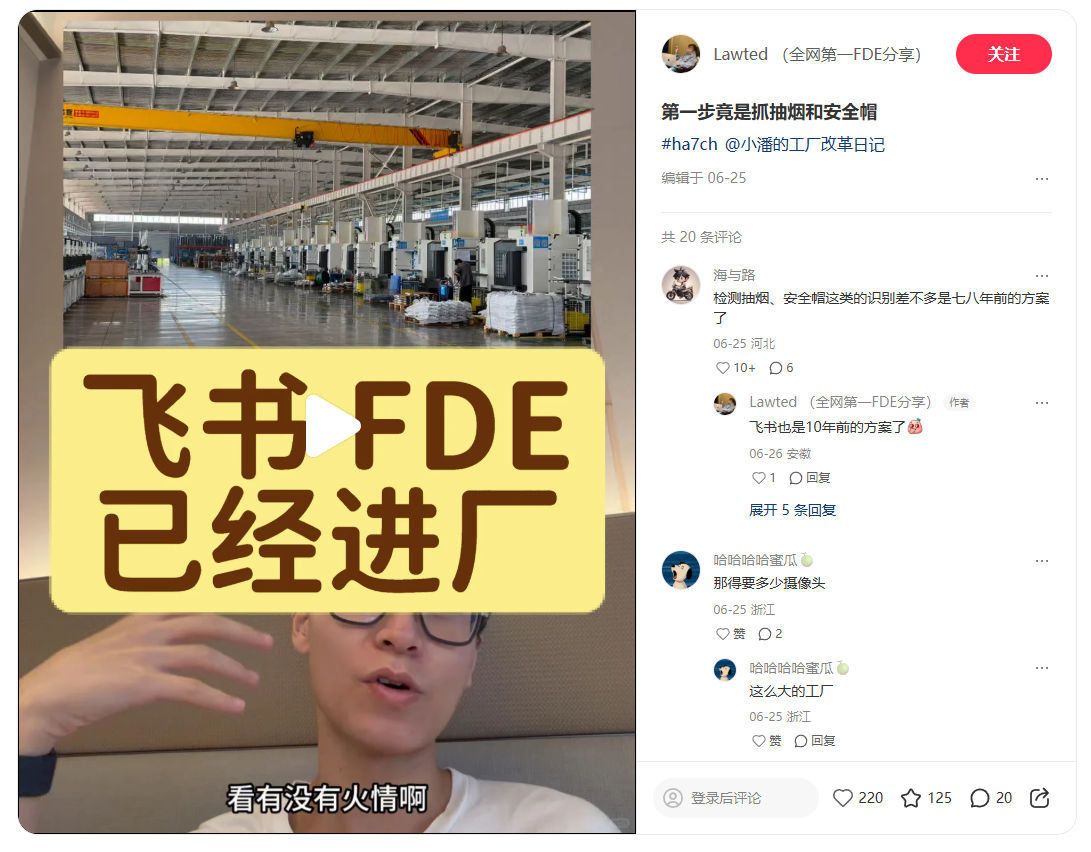
I don't know what the factory's most pressing problem was, or what business actually needed AI integration. But based on my experience in manufacturing, issues like product yield, equipment uptime and downtime, material waste, order delays, or process quality are all far more urgent and important than monitoring employees smoking or wearing hard hats.
The Feishu team's motivation to deliver results quickly when entering an unfamiliar domain is understandable, but choosing such a non-core, low-barrier scenario to showcase is hardly convincing evidence of their FDE team's delivery capabilities.
Rather than calling this FDE, it's more like they were just trying to land Feishu as a product. Finding problems with a product already in hand, forcing a "digitization + messaging" way of working into the environment — this is a classic elite trap: good at solving problems, bad at choosing problems.
FDE should re-examine the business on site, not transplant an existing system there.
No wonder they ended up busy for six months only to be absorbed by Doubao and Volcano Engine in the end.
OpenAI and Anthropic chose a different approach.
When Feishu did FDE, it already had a mature product, sales targets, and organizational interests backing it.
OpenAI and Anthropic, on the other hand, carry none of those product baggage.
Whether it's Codex or Cowork, both are too new to have formed internal interest groups revolving around existing features, sales commitments, and product roadmaps. When teams enter customer sites, they can treat the model as raw material and redesign AI applications from scratch for the customer, without having to first figure out how to fit the customer into an existing product system.
Codex Labs directly sends OpenAI experts into enterprises to identify and deploy applications; Anthropic, meanwhile, trains large-scale FDE teams through partners, integrating Claude into customers' existing systems and operations.
This also explains why both companies saw their headcount investments grow rapidly the moment they started doing FDE.
Models can be replicated; customer problems cannot.
Every company has its own business processes, permission structures, legacy systems, and departmental interests. A solution that worked at one company likely needs to be redone from scratch for the next customer.
AI hasn't eliminated the heavy human investment in ToB services — it has simply reorganized the work that used to be hidden across sales, consulting, implementation, and customer success teams, and put it under the new name FDE.
Feishu's FDE is tasked with promoting a mature product, using process-driven Feishu to solve intelligence problems. OpenAI and Anthropic's FDE, by contrast, is about re-starting a business at the customer's site, using the model to help customers rebuild their operations.
These two approaches both go by the name FDE, but they are fundamentally different things.
What FDE truly needs to deploy is entrepreneurial capability.
Tech elites always think enterprises buy products. In reality, enterprises buy a complete service with someone accountable for it.
Feishu's FDE problem is that it deployed a product to the site rather than deploying the capability to solve problems. The so-called "going deep into the business" ultimately became about finding landing scenarios for an outdated product.
FDE doesn't automatically materialize just by hiring more engineers who understand technology and can be stationed on site. The key to whether the business works lies in whether the company is willing to hand over a portion of product definition authority to the field.
The team needs to judge on site what is worth doing and what isn't. It must be able to draw on the company's engineering and product resources to solve customer problems, and it must also be able to abandon existing product roadmaps and assemble new solutions for the customer.
This is closer to entrepreneurship than to delivery.
Entrepreneurship requires temporarily forgetting what products you already have, re-understanding what difficulties the customer is facing, finding places worth changing, and then taking responsibility for the results.
If a company isn't prepared to start over entrepreneurially, and is just giving its stationed engineers three new English letters, it will eventually end up either as a wish-granting machine for the client or as a sales team wandering around with a product, looking for problems to fit it into.