How should we define FDE?
Over the past year, if there is any service model closest to AI implementation, FDE absolutely counts as one. Yet for a long time, our definitions of FDE have not been unified.
Some understand it as engineers stationed on-site, some emphasize business understanding, and others explain it as a running-alongside service. But these descriptions are all strange.
If it were only about "people present at the customer site" and "understanding the business," China would have already been a major FDE country 20 years ago. Pre-sales, outsourcing, deployment, and implementation have always been real-world operations, and we have never lacked industry experts.
The reason we need a methodology called FDE is not because people in the past were too far from customers, but because with the previous to B service model, it was difficult to sell AI with real value and at a real price.
Traditional to B services usually have the client raise requirements and the vendor take responsibility for implementation. But the biggest problem with AI is precisely that customers themselves do not know where AI should be used. If we still wait for customers to define their requirements clearly first and then hand them over to suppliers for execution, AI implementation becomes merely adding a few new features to old processes.
So what FDE truly needs to change is not where engineers sit, but who defines the problem.
A true FDE should not just execute requirements with a better understanding of the business; it should be able to enter the business site and then re-judge requirements. Its core business is not the qualification of being on-site, but the right to define problems.
But when we look at those doing FDE, we find that small companies end up as outsourcing providers, big companies turn it into pre-sales, and consulting firms eventually turn it into running alongside. Why?
It is hard for genuine FDE to grow in the Chinese market.

For most small AI companies, the biggest problem with so-called FDE is not lack of business understanding, but lack of bargaining power. Once the plan is set, the contract is signed, and the team moves into the field, what happens when they find the plan is wrong and needs to be overturned? Nothing can be done. A small team in a small company has neither the confidence to overturn customer requirements nor the ability to redefine them.
So for small companies, FDE can only end up becoming outsourcing—a bunch of people noisily using AI to reinvent customer needs.
What about big companies and consulting firms?
They all have enough bargaining power, but for big companies, deploying their own intelligent agents, models, cloud services, and various office suites is more important than helping customers solve real problems. The FDE of big companies enters the field with answers already in hand—the question they need to answer is "which business link of the customer can use our products."
The FDE business of consulting firms is even simpler: they repackage their previous consulting + solution + supervision execution service into full-process "accompaniment," adding a layer of 24/7 response and full-process solicitous care, which is the so-called "running alongside." More advanced consulting firms even "self-develop" an Agent, shifting part of the "Q&A" pressure to a Chatbot, calling it AI-enabled—old wine in new bottles.
So the problem has never been whether FDE goes deep into the field, but whether the frontline team has the qualification and the willingness to redefine problems.
We did not suddenly see a new enterprise service model just because of the term FDE. The original client-vendor relationship has not changed, and FDE can only be reshaped by those relationships into something we have long been familiar with.
With a hammer in hand, everything looks like a nail.

Even if the frontline team is given the right to define problems and is asked to think entirely from the enterprise's perspective, they may ultimately find that many enterprises' most urgent problems are not AI transformation at all.
For example, what most manufacturing enterprises genuinely worry about may be insufficient orders, over-reliance on a single large customer, a broken talent pipeline where the production line cannot start without veteran workers, or the next generation unwilling to take over the business, or traditional relationship-based management no longer able to support the enterprise's growth.
Any one of these problems is more important than "which department should deploy an Agent."
Many so-called AI transformations are not because enterprises need AI transformation, but because enterprises are first made to accept the conclusion that "we must do AI," and only then are business scenarios sought. I also discussed this phenomenon in "The 7 Big Pitfalls of Traditional Enterprise AI Transformation."
Needs should precede solutions—this has been common sense for decades. But in this round of FDE fever, we have violated common sense, doing for the sake of doing, and doing it happily.
Even if during FDE implementation a scenario where AI could intervene is genuinely found, it does not necessarily mean AI must be used.
Using multimodal recognition to detect workers smoking is very "AI." But how much does an enterprise have to pay for this business? The Feishu FDE team probably cannot be bothered to calculate.
A true FDE even needs to say "no" to AI.
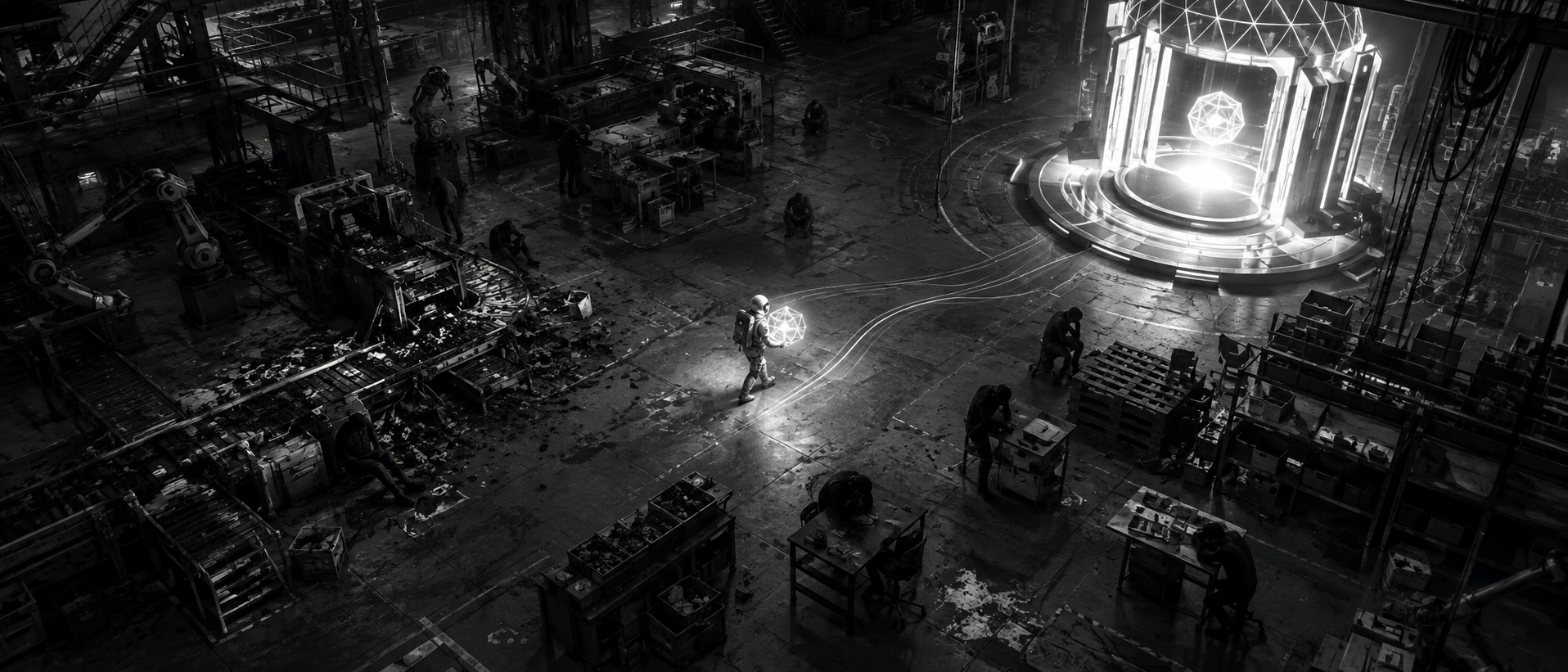
If an FDE team enters the customer's frontline and finds that solving the customer's problem should not use AI, what should they do then?
In today's context of "AI transformation," this is the most difficult conclusion to voice.
Looking back at the origin of FDE, Palantir did not invent the FDE model because of AI. This model was already Palantir's core delivery method long before the AI era. It merely continued to retain strong vitality after extending into the AI era, which is why people cite it as a methodology for AI implementation in to B scenarios.
So FDE has never been a delivery method that exists for AI, but a methodology for solving customer problems.
But when a project is defined as AI transformation from the start, FDE entering the field is no longer about judging how the customer's problems should be solved, but about proving how AI can solve the customer's problems.
It becomes a tool for suppliers to reinvent problems, rather than a method for solving customer problems.
A true FDE should answer what problems the enterprise actually has, rather than asking the enterprise where AI can be used.
The Chinese-style FDE that defies common sense is doomed to fail.