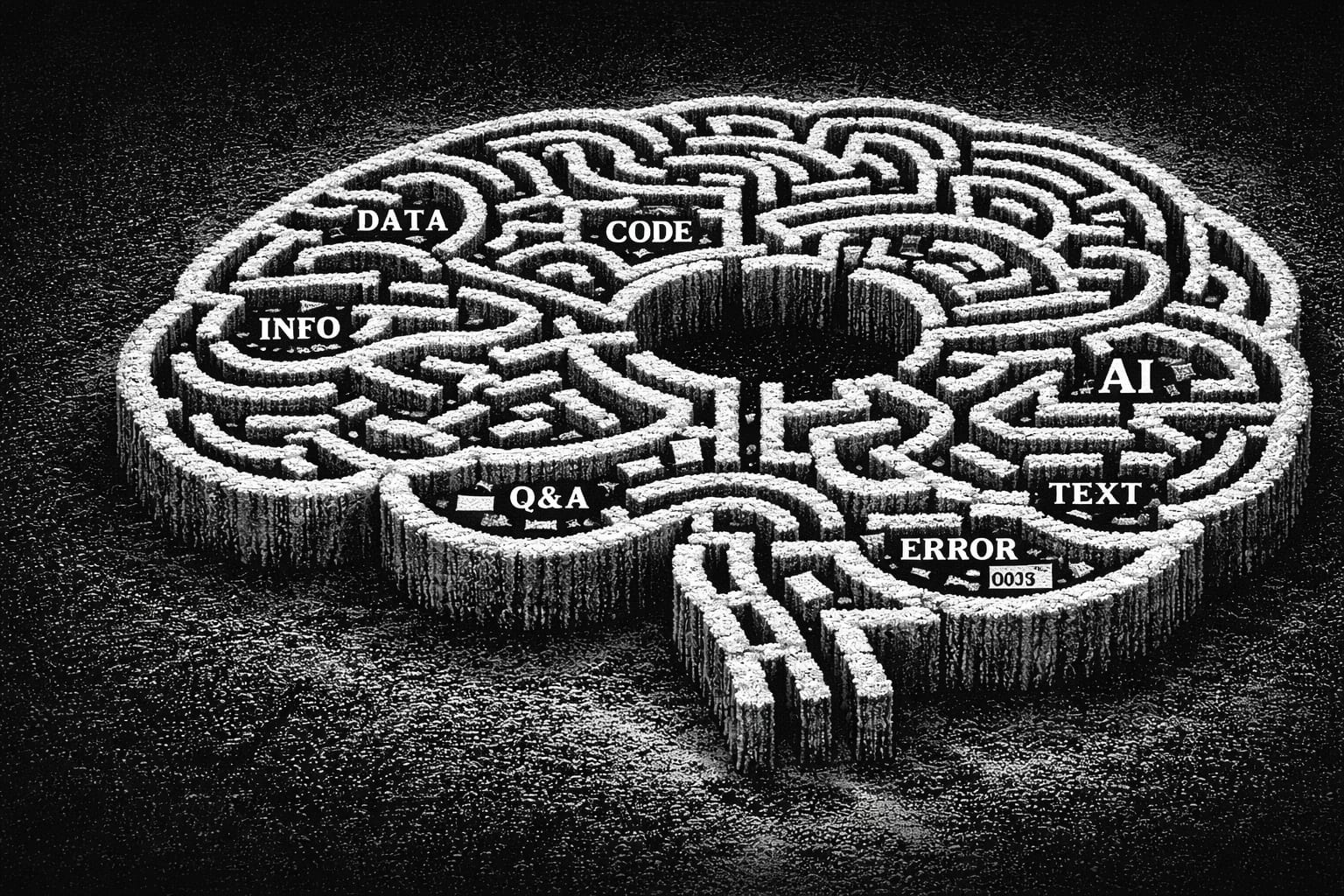
In the past few years, more and more people have become accustomed to using AI (LLMs) to handle various problems, gradually getting used to treating AI as their "second brain." It can answer questions, write, code, analyze, and offer advice. Many times, its performance is even more stable and efficient than humans. Most of the time, we think it is omnipotent.
However, after deep use, some strange issues begin to emerge. For example, it can be very smart locally but lacks consistency overall. Sometimes it grasps the key points, other times it gets stuck on details; sometimes its judgment is clear, other times it seems to lose direction.
And of course, there's the unavoidable issue: it often "fabricates."
These problems are inherent flaws. After all, for a probabilistic model, all its outputs are, philosophically speaking, false—they are guesses. But if you are a deep user of AI-first approaches, you'll find that these issues arise not only from its flaws but more fundamentally because it is not a true "silicon-based brain" and lacks the ability to think.
LLM-type AI excels at processing information, but thinking is more than just processing information. The basic premise of thinking is that you must be able to distinguish the "priority" of things. When humans make judgments, there is always an implicit ranking—they preprocess known information, deciding which information to prioritize, which to ignore, and which to defer. This ranking is implicit.
In AI, this layer is missing. So you see familiar phenomena: key premises gradually fade in long conversations, trivial details are repeatedly amplified, and the focus of each response drifts. This is not just a misunderstanding; it's more like there is no stable priority system supporting the output.
Text is a tool that relies on imagination to convey information. So if the sender lacks the ability to describe facts, and the receiver lacks imagination or has too much of it, the entire information transmission process becomes a disaster.
LLM is a system that relies solely on text for reconstruction. What it receives, from the start, is compressed information. What it outputs is a high-probability restoration based on incomplete information.
In this process, humans use experience, feedback, and real-world constraints to correct understanding, but AI lacks these. It can only continue to infer within the text space. So sometimes it appears very accurate, other times completely off, because it is constantly using limited information to imagine a world. Humans use imagination to compensate for the inadequacies of language, while AI has only imagination.
When OpenClaw was trending a while ago, I didn't follow the trend, even though I had been tracking it since its inception. I understood that its biggest feature causing a sensation was in the human-computer interaction layer. A concrete character image and spoken interaction gave OpenClaw the potential to serve ordinary people. But at the same time, fully spoken text interaction also amplified the flaws of the core LLM driving it.
Current agents lack a reliable memory system.
The reason human judgment can gradually converge is that memory is constantly at work. The decisions you've made, the pitfalls you've encountered, and the preferences you've formed are repeatedly invoked in subsequent judgments, gradually strengthening and eventually forming a relatively stable cognitive structure. This structure is not perfect, but it gives your judgment continuity.
Currently popular agents mostly rely on markdown or so-called RAG as memory systems, but their flaws are very obvious. I won't go into RAG, but the biggest problem with markdown is that it is just a storage format, not a cognitive structure. People can use it to record information, but they cannot express relationships. Moreover, it is static—content written in it hardly changes. A judgment that has been overturned and a conclusion that is still valid have no essential difference in the system. It is neither corrected nor eliminated, only accumulated.
Such memory systems only allow AI to see more information, not to truly form judgments. What truly determines the quality of judgment is never the amount of information, but how information is filtered, organized, and forgotten.
An agent lacking a reliable memory system is just a more user-friendly information manipulation tool, unable to solve the problem of how to use the tool well.
We can see many researchers and AI-first insiders using AI with great skill. They can provide AI with sufficient and rigorous contextual constraints, keeping the output within a controllable range. This shows that, purely in terms of model capability, it already meets the needs of most people. So what we should think about is how to make AI truly serve non-professional users.
Giving AI a brain is not about stuffing it with more context, but about equipping it with a three-dimensional, lifecycle-based memory system.