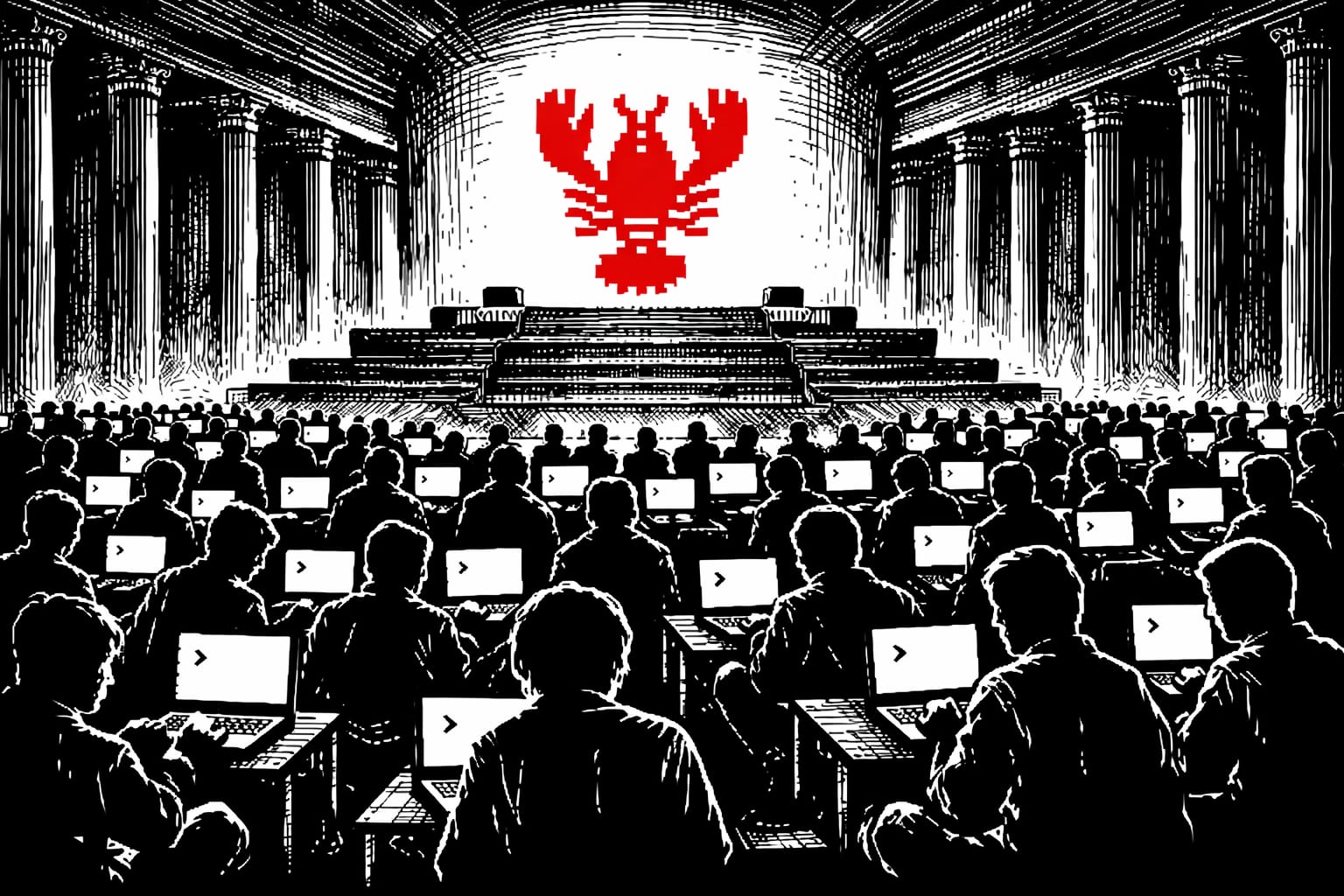
In recent days, a peculiar craze around OpenClaw has emerged in China. Some cloud computing companies have started hosting offline events, teaching people how to deploy OpenClaw for free; some crypto industry practitioners are organizing so-called "AI + Web4" themed gatherings; and even professionals from the catering industry are using this topic for offline sharing, claiming that stores can improve efficiency through OpenClaw.
I've seen quite a few photos from these events, and they're very interesting. Many people show up carrying laptops, with individuals of different ages mingling together. Some are searching for WiFi everywhere, while others follow the projection screen step by step, typing Git commands in the terminal. The entire scene has a peculiar atmosphere of pilgrimage.
What struck me most were some participants with graying hair. They sit quietly in corners with old computers they've used for years, waiting for the system to slowly run complex Agent environments. There's a subtle mismatch between aging hardware and cutting-edge technology, like a real-world cyberpunk scene.
This makes me ponder a question: why are people so enthusiastic about OpenClaw?
If they were tech enthusiasts, this phenomenon would be easy to understand. Open-source projects have always had their own communities, and those who love tinkering are naturally drawn to them, accustomed to trying out new tools. But judging by the atmosphere at the events, many people clearly don't belong to this circle. They seem more driven by an emotion that brings them here.
This emotion repeats itself throughout internet history.
Whenever a new technology is portrayed as a force that will change the world, people start looking for their place within it. A decade ago, people discussed internet finance; later came self-media, short videos, and cryptocurrencies; now it's AI's turn. Media and social platforms are filled with similar narratives: "Build an AI automation system in three minutes," "Ordinary people can have AI employees too," "Start an AI business without knowing how to code." In these stories, technology appears as an opportunity with an extremely low barrier to entry.
Thus, an interesting phenomenon emerges. Many people install OpenClaw not because they already know what they'll use it for, nor because they understand its technical principles. They simply feel that if everyone is talking about AI, they'd better install it first.
In a way, this behavior is more like a symbolic ritual.
For some older participants, this motivation might be even more complex. Over the past few decades, they've experienced multiple technological transitions. From the early internet to mobile payments, from forums to short videos, the pace of technological change has accelerated. When a new wave of technology arrives, people easily develop a fear of being gradually left behind by the times.
In this context, installing a seemingly advanced piece of software brings a sense of psychological security. When an icon symbolizing AI appears on the desktop, when they can talk about Agents and tokens, this behavior makes them feel they're still participating in this era.
Here, the software is not just a tool; it's more like a symbol. It symbolizes a sense of belonging, a sign that they're still standing at the entrance to the future.
If we zoom out on the timeline, this is actually a cyclical social phenomenon. When new technological narratives emerge, people try to participate in some way. Some truly create new products and industries, while many more just stand at the door, hoping to confirm one thing.
They're not simply installing a piece of software.
They just want to know whether, when the future arrives, they'll still be part of it.