On September 5, a serious accident occurred at the China GT Shanghai round. The event organizer was undoubtedly cursed onto the trending searches and became famous overseas in a strange pose.
If not for the sharp eyes of helpful netizens, who kept asking who exactly that old man was—the one who couldn't even open a fire extinguisher and was obviously not professionally trained—and why he was assigned to the rescue scene, the old man would have been hung online and dried into a wax figure by now.
In the whole incident, whether it was the organizer still emphasizing after the accident that "the event configuration meets national-level event configuration," or the old man who was forgiven afterward, for many outsourced workers this should all be familiar. Isn't this exactly the plot repeated every day?
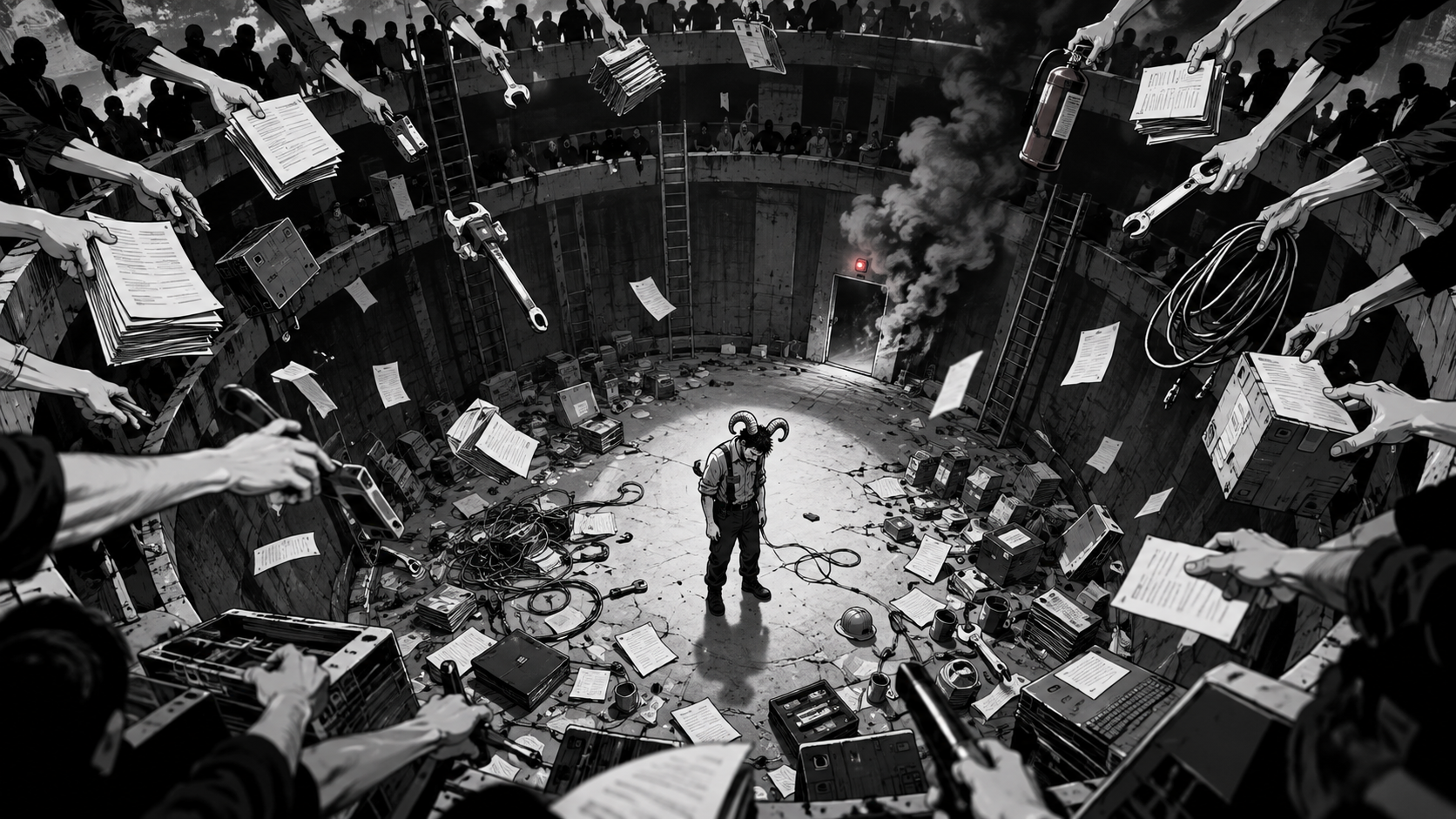
No onboarding training at all, yet on the first day of work you have to rush up and fill the trenches. Project documents rely entirely on imagination; the pits left by the previous hand are all blindly guessed and randomly changed. In the end, when the project goes wrong, you're the first one pushed out by your leader as a sacrifice.
Luckily, the old man had a lucky star, and netizens didn't rip through his underwear. But the vast majority of outsourced workers don't have such good treatment; no helpful netizen will speak up for you.
Although you have to take on many jobs, and you have to shoulder many things, if your posture is wrong and something goes wrong, you'll really be in trouble.
Outsourced workers die from being too capable.

Normal outsourcing is outsourcing business to an external team. Wrong outsourcing is routinely stuffing labor dispatch into a certain business node.
Many brothers doing on-site outsourcing are actually doing the second kind. They were originally laid off from factories and, unable to find reliable work, had no choice but to do outsourcing. How they worked in the factory is how they still work as outsourced workers. When the leader gives a task, they do it; if no one hands over, they study it themselves; if the schedule can't keep up, they take the initiative to work overtime.
But everyone knows that when a company uses outsourcing, what it wants is cheapness, convenience, and monthly disposal at a moment's notice. Training and benefits are all absent, and a single phrase—"there's a chance to become a full-time employee"—hangs over you to make you work desperately. An excellent outsourced worker will always just be an outsourced worker, so when you are very capable, the trouble is huge.
Because you will take on many responsibilities that you shouldn't have to take on.
Rights and responsibilities are one. Only when you have decision-making power and resource-mobilization ability matching the responsibility can you bear responsibility for the result. For an outsourced worker who is too good at "getting things done," if you do well it's not your credit; if you "screw it up," you bear full responsibility. So what an outsourced worker really needs to learn is to do the work with "justified reasons," "clear sources," "clear goals," and clear responsibility boundaries.
Otherwise you are that firefighting old man pushed out by China GT to be sacrificed to netizens.
How to become a qualified outsourced worker?
The biggest problem for many outsourced workers is that they don't realize they are outsourced. Even though their badge color is different and they have no benefits at all, once they start working they are still full of an owner's spirit, thus lowering their guard. So as an outsourced worker, you must always be clear about your identity and position; this is the first core principle for staying alive.
Even if you have firmly remembered your identity as an outsourced worker, many times the higher-up will say: "Take a look at this." You will still reflexively immediately check documents, look at logs, and work furiously.
Most outsourced workers' troubles start with this sentence.
Even if you clearly know which project, which function, and which part of the business "this" is related to, and you can even directly guess what "he" wants you to do, you still need to ask clearly: "Do you mean you need me to do this, this, and then that?"
Don't be afraid it will make you look stupid, and don't think you are smart. Even if you guess more or less correctly, you must obtain explicit authorization. Otherwise, if you do it right it has nothing to do with you; if you do it crooked, it's a problem with your ability; if you do it wrong, it's you acting on your own.
At this point, don't think everything will go smoothly. Obtaining specific authorization for a specific task is only the basic requirement for you to be able to do the job. You'd better also report to the higher-up how exactly the job is to be done.
For example, if the leader asks you to change an online function, and after looking you find it's something you can finish in just 5 minutes, you still need to say something to the leader. Especially for sensitive operations, even if they are done and there's no problem, if there was no prior synchronization, it can still be brought out to be sacrificed as a flag.
You need to leave a clear origin for your work in the system, and ensure every step has sufficient explanation. Never let your leader disappear midway.
Conversely, don't do things beyond the scope of authorization. Only complete the work that the leader explicitly authorized, that you reported to the leader, and that clearly states you are responsible for.
If you don't have permission, apply for it; follow the process when it should be followed; don't borrow accounts or bypass approvals; don't do it first and talk later; and don't discuss company rules with your leader. Keep your leader present the whole time; even if he doesn't want to be present, make him be present.
Once you've done this to this extent, you can basically be considered a qualified outsourced worker.
The company only protects the system, so you need to be inside the system.

Work when you should work, do things when you should do them, but always keep a clear understanding in your heart. The company is not home. Don't wait until something goes wrong to discover that you are outsourced. The company doesn't care whether you are outsourced; it only cares whether someone is responsible for the matter.
A requirement that isn't put in writing doesn't count as a requirement; authorization without a "signature" is exceeding authority. The company only protects the system, and the system only recognizes records left in the system.
The most painful part for outsourced workers is that they are too close to the accident and too far from the company. Many times you did the work, but the authority wasn't given by you, yet you carry the responsibility. So for many companies, outsourced workers are simply the best consumables, professionally solving friction within the organization.
The old man in the China GT accident who couldn't open the fire extinguisher is exactly such a perfect prop.
So don't wait until things catch fire to realize you're standing in the position most suitable for taking the bullet.
You can't count on helpful netizens discovering that you're an outsourced worker when the moment comes.